
Showing posts with label soccer. Show all posts

Thursday, November 22, 2007

European Nights

Wow, a month since I last posted, school seems to be killing me in more ways that one. Ok, so today it's time to go through the Euro-Cup predictions that I made (not here, but to my friends), and see how right I was. I will list the teams I thought would make it, then the teams that did, then talk a bit about each qualifying group, with a special section at the end for the hosts, and whatever else I want to talk about. So here we go.

Group A: Predicted- Portugal, Serbia. Qualified-Poland, Portugal. Once again Poland threw me off. Last year they scored more goals than any team in the World Cup qualifying campaign, and then played terribly at the tournament. I really should have known better...and Smolarek is scoring goals like they're going out of style, which makes sense since he's named after Eusebio. There was no doubt Portugal were going to make it through, even without Luis Figo. In fact, I think the team as a whole looks better without him, since everyone has to step up and pick up some slack. Hats off to Christiano Ronaldo, and Ricardo Quaresma who had a great campaign. Also, Scolari punching out an opposing player was the Portugese highlight for me. Poor Serbia. I was so sure they were going to make it, but a few bad results against key teams really sunk their chances...but there's always the World Cup.

Group B: Predicted-Italy, France. Qualified-Italy, France. Despite their best results in recent history, Scotland failed to qualify out of this group, which to me was the hardest of the lot. This is a real disappointment, not just for Scottish fans, but also for the neutrals like myself who were rooting them on the whole way. Sure, I may have been cheering for them because I hate France, but that's not the point. Speaking of France, no team deserved to qualify less. Domenech is a racist, loud-mouthed buffoon, and I can't believe he is still allowed to coach a professional team...not to mention he's been leaving his best striker, David Trezeguet, at home. As for Italy, what can I say? A rough start had us all on our toes, and only a hard win against Scotland got us through. I don't like the look of Donadoni's team very often, but he appears to have scraped us through. Well, top of the group isn't bad for the world champions...I guess...

Group C: Predicted-Turkey, Greece. Qualified-Greece, Turkey. Despite a last-gasp effort, the Norwegians fell short, again. Apparently this isn't so bad for Norway. My Norwegian friend (hereafter known as The Norse god of Rock) tells me that the nation lacks the winning mentality of Italy or Germany, and so third place is a great result for them. I may have slightly underestimated Greece this time, thinking Turkey would return to show them who's boss, but I wasn't too wrong. After their surprise victory in Euro 2004, only an idiot would discount the Greeks this time around. As for the Turks, the Altintop twins rule...I just wish I could tell them apart. Their presence at the Euro-Cup will puzzle me, as they are clearly not a European nation (just ask the EU)...sorry Aydin, give us back Constantinople and go win the Asian cup five years in a row.

Group D: Predicted-Germany, Czech Republic. Qualified-Czech Republic, Germany. The Germans are looking good, and to my mind are an early favourite to win the whole thing next summer. The only reason they placed second in the group was because they didn't want to place first and be seeded in a difficult group...heh, and you all thought Italians cheated. Ireland failed to qualify and were booed by their own fans after their final match. Maybe this will give the FAI the shot in the arm it needs to get things straight and start winning again.

Group E: Predicted-Croatia, Russia. Qualified-Croatia, Russia. No surprises here, unless you are and English fan, and you don't watch any soccer outside of England. Croatia have one of the best teams in Europe right now, and their win at Wembley today proved it. How anyone can underestimate the "Brazil of Europe" baffles me. Russia proved once again that Guus Hiddink has magical powers. He is clearly one of the best coaches in the world, and I truly hope Italy are drawn in a group with Russia so we can prove to him once again that his great coaching can only beat Italians if the ref is on his side. Full credit to the Russians though, they had a great campaign, as did Isreal, who finished tied on points with England. As for England, see below.

Group F: Predicted-Sweden, Spain. Qualified: Spain, Sweden. Spain may have gotten their act together for a few games, but how long will that last. How long until Aragones makes another racist remark? How long until regionalism rears its head and tears the team apart? My guess is during the knockout rounds at the tournament next summer. Sweden played the way I expected, although Zlatan Ibrahimovic, arguably the best forward in the world, still isn't showing his potential on the international stage (but he is at the Internazionale stage...). This group was home to my greatest disappointment. Northern Ireland deseved to qualify. The tiny nation beat both Spain and Sweden, and I believe Healy is the tournament's top scorer. George Best would be proud...and then he'd have another drink. (RIP BESTIE!)

Group G: Predicted-Netherlands, Romania. Qualified-Romania, Netherlands. The Netherlands finished only one point ahead of Bulgaria...not the campaign they were looking for. If they get their act together (which will happen when America admits it lost the war in Vietnam) then they can be world-beaters, but for now they'll just content themselves with putting in a good show at the Euros. Romania had an excellent campaign, which is no surprise to Italian soccer fans. Christain Chivu and Adrian Mutu are two of the best players in Italy, and I'm glad they've proved the're two of the best in Europe as well.

The Hosts- Austria, Switzerland: I have no doubt that Switzerland would have qualified for the tournament had they been forced to. Since the Swiss-German Only regime ended, the team vastly improved. With Frei, Barnetta, Yakin, and Grygera, I think they have a shot at making it at least to he knockout stages, and possibly quite far if their fans can get behind them. As for Austria...wel...their fans signed a petition to pull them out of the tournament because they don't want to be humiliated (like Canada was at the Under-21 Championships), and I can't blame them. Austria was great in the 1950s, and their only notable moment since then was cheating with Germany to knock an African team in a world cup. My guess is that they will place last. Sorry guys.

Italy: Ok, I need to get on my soapbox here. So we qualified, and overcame the post-World Cup Victory jinx that we suffered from last time we won it. And sure, we looked good against Scotland for large periods of the game...but in many of the other games, I was left asking myself why an amateur British team was wearing blue shirts and combing their hair so often. I applaud Donadoni for trying out new players, Particularly Chiellini, Quagliarella, Nocerino, Palladino, and Commandant Che Gue....I mean, Christiano Lucarelli. Antonio Di Natale has proved the best of the new additions, and I will be surprised if he doesn't become a permanent fixture on the team sheet. BUT (theres always a but) very often the team I saw wearing Azzurri shirts lacked all creativity and flair. They battered their way through teams, with none of the style we've come to expect from them. This is possibly due to the lack of Francesco Totti in the midfield. Whatever the problem is, we have the players to win the Euro, all Donadoni has to do is mold them into a coherent and determined squad that plays for each other and not themselves (which is what Lippi did to bring us home the World Cup). And, if we're lucky, there will be another scandal in Italy right before the tournament that will give us the added incentive to beat everyone again and prove our superiority in Calcio.
England: I have a lot to say here, but first I want to make something clear. The English invented the modern game, and I watch the Premiership and the national team as much as anybody, so don't take this criticism as Latin racism against Northern Europeans...it's simply a footballing point of view, nothing more. OK, with that said, who to blame? Well, I have a list, so let's get
started on it.
Steve McClaren: Sure, it's a cliche response to make the coach into a scapegoat, but let's face it, McClaren seems to truly lack an understanding of his team's (former team's...I just found out 5 minutes ago that he's been sacked) strengths and weaknesses. I'm glad he changed things up and tried out new players, but his overemphasis on "star players" to the detriment of the team is inexcusable. It's not that English coaches are bad, as some have suggested, it's just that McClaren is an assistant coach at best, and his appointment as England coach was doomed to failure.
The Players: Obviously, it was the players themselves who lost the games, not McClaren, but which ones? I think as a team, this lot didn't show the drive and determination that we expect from an England team. Most importantly though, they did not really look like a team, but rather like a group of individuals playing on the same side. This, to my mind, was the fault of the players. Shut up, get along, and play for each other.
The FA: Alot of people are going to say that foreign players in the Premiership has finally screwed England, and I'm still not sure of the truth of the matter. It seems to me that so much focus is on signing a new foreign star that most of us can't even name 30 English players in the Premiership...let alone the younger ones. Maybe this has less of an effect than we think, but there's really no way to find out. Maybe the FA should enforce a minimum number of starting Englishmen, and see if there's any long term effect. Right now, anything is worth trying once.
The British Media: These are the people I think deserve most of the blame. The media makes it so hard to play for England that you can't blame the players for faltering. Before games they convince everyone (even the players) that the team is unstoppable. No hint that the players are people, no...they're Gods, who only have to walk out onto the pitch and victory is secured, no matter their opponents. Confidence is great, but this kind of overconfidence is detrimental to the team. Why try if you and the rest of the world know that you don't need to try, and you'll still win? Then, after the game, when England has invariably lost, the media tears the players to pieces. For crying out loud, they're PEOPLE! People makes mistakes, people have off-days. Destroying them in the press merely destroys morale, and ensures that they will not be up to standard next game. Maybe England should impose the kind of media blackout that Italians use leading up to major tournaments. The players are cut off from the news, and so they only worry about themselves, and their game. I think this would do alot of good. Bottom line, the media needs to be gagged, silenced, and if possible, beaten.
Final Rant, Joe Cole: I personally put much of the blame for this whole debacle on what I call the "Joe Cole Syndrome". Essentially, it goes like this: Joe Cole is England's most gifted and creative player, yet the amateurish strictures of the English game force him to play in a style that he is not suited to. He is best as a creative central midfielder, and needs to play on a team that supports him in that role. However, the English tactics are based on one-dimensional long-ball players like Terry and Lampard. Give Joe Cole the freedom to play, drop the players who can't think during a game, and you'll see the difference...I'm willing to bet money on that fact.

Ok, that's it for now. To end off, I'm going to list the teams that are in the Euro and the draw pots they will be in. There will be 4 groups, with one team per-pot in each group. Ciao for now, and Forza Azzurri!!!!

Pot 1: Greece, Austria, Switzerland, Netherlands
Pot 2: Italy, Croatia, Czech Republic, Sweden
Pot 3: Germany, Romania, Portugal, Spain
Pot 4: Russia, Poland, Turkey, France

Friday, August 31, 2007

Soccer Season


Every year when soccer starts up again I can't help but make loads of predictions. Nobody ever listens to them, but last year I got them all right. This has prompted me to start recording my predictions so I can prove it to people who don't believe me 6 months down the line. Today I'm going to start with the Champions League group stage, since the draw was just the other day. I'm going to list the teams from each group in the order I expect them to place, and then explain why. Ok, here it is.


Group A: Liverpool, Porto, Marseille, Besiktas. Liverpool clearly dominates this group. Their European form is impeccable, and their team is even stronger this year than it was last year. I wouldn't be surprised to see them in the final four again. Portuguese teams are always difficult, so I feel Porto will finish second. As for the other two, it's really up in the air, though I think Marseille's greater experience at this level will see them into the UEFA cup over the Turks.


Group B: Chelsea, Valencia, Schalke, Rosenborg. Despite my hatred, I must admit that Chelsea are a great team. Aside from their skill, they have the psychological edge over Valencia after defeating them in last year's competition. Schalke's recent troubles will see them overcome Rosenborg, but Valencia will be too big a team to beat this time around.

Group C: Real Madrid, Lazio, Werder Bremen, Olympiacos. Real Madrid, despite winning more Champions League titles than any other team, are a bit of a wild-card lately. Sometimes they are untouchable, and sometimes they play like me and my friends in the backyard. I think they will progress out of the group phase, but no further. Lazio (my most hated team in soccer) have found a squad and a style that works very well for them...unfortunately. Bremen are decent, but not world beating, and Olympiacos will suffer from both the aftermath of the wildfires in Greece, and the recent scandals that have hit Greek soccer.

Group D: AC Milan, Benfica, Celtic, Shaktar Donetsk. This group is very hard for me to predict, so I want to say that apart from Milan in first, the other three spots are up in the air. As reigning champions, Milan are still that favourites to take the title again. Benfica and Celtic are both strong in different aspects of the game, and so either one could go through. As for Shaktar, with the current quality of Ukrainian soccer, and the addition of Christiano Lucarrelli, I think they may surprise people. Like I said, after Milan, I'm not too sure.


Group E: Barcelona, Stuttgart, Lyon, Rangers. Barca are always favourites, and now is no exception. Stuttgart will be riding high after their Bundesliga victory last season, and should overcome struggling Lyon who never fare well in this competition anyways. Rangers may be getting better, but just cannot compete in a group as ludicrously tough as this one.


Group F: Manchester United, Roma, Sporting Lisbon, Dynamo Kiev. United just may get out of this group undefeated...unless Roma have something to say about it, that is. After last year's violence, and the 7-1 debacle, I think Roma-Manchester will be the rivalry of the entire group phase. Though good, Sporting and Dynamo are up against two of the best teams in the world, and so will battle amongst themselves for third place and the UEFA Cup spot.


Group G: Inter Milan, PSV Eindhoven, Fenerbahce, CSKA Moskow. Inter will take this group, and then crash like they always do. All three of the other teams could take second place, but the Dutch have far more experience at this level than the Turks or the Russians. Fenerbahce are playing well, and so may defeat CSKA...though the Moskow side is my personal favourite in this group, and I want to see them pull off a major upset and advance to the round of 16.


Group H: Arsenal, *Sevilla, Steaua Bucharest, *AEK Athens, Slavia Prague. Ok, this is weird because the Sevilla/Athens game has not yet taken place, so we don't know who will be in the group yet. Arsenal should win comfortably, though Sevilla is the best team in this group. Steaua can surprise some of the bigger teams if given a chance. AEK will likely suffer if they qualify, though Slavia Prague have been out of the Champions League for a while, and will likely come in last.

Ok, there you have it. I really hope some of these results don't turn out the way I predicted them, since most of the teams I like in these groups are the smaller sides. Oh well, in soccer anything can happen. Forza Juventus per sempre! Ciao.

Sunday, July 29, 2007

Baghdad F.C.


Today the footballing world was stunned by what can be achieved by 22 men full of pride and determination. By "the footballing world" I mean the 95% of the globe that is obsessed with soccer, and the 22 men I'm referring to are the players on the Iraqi national team. Today Iraq pulled off on of the biggest upsets in soccer history, and achieved an incredible and historic victory by overcoming Saudi Arabia in the Asian cup final.

First, let me give you some background. The Asian Cup is a gigantic tournament that pits all the nations of Asia, from Lebanon to Japan (and now including Australia) against each other in order to crown the continent's best soccer team. Despite a better parity in quality than that found in Europe, the tournament is always dominated by South Korea, Japan, Iran, and Saudi Arabia. Iraq has never placed better than fourth, and that was long before the current situation over there began (in the 70s I believe). Saudi Arabia, on the other hand, has won the tournament three times, and looked the favourites this year as well. The Iraqi captain, Younis Mahmoud, broke Saudi hearts with his excellently controlled headed goal late in the game to secure victory for Iraq.

It is very difficult for me to fully express the shock, and joy, I feel at seeing the Iraqi team overcome difficulties that would destroy most men. All 22 players have lost loved ones in the ongoing war in their homeland, and the team was forced into exile a few years ago due to security reasons. To see them triumph now is not only a victory for soccer and its ability to bring people together in times of hardship, but also a victory for humanity. These men have proved that even in the midst of pain and fear, it is possible to do great things.

Please keep these men and their families in your thoughts and prayers, along with everyone else who has been affected by war, violence, death, and pain. Ciao, e grazie.

Monday, July 9, 2007

Er Santo di Roma


I was asking myself the other day why these idiots in North America fawn over celebrities so much. Why are dozens of magazines devoted to revealing the most intimate details of people we will never meet? Why do we even care? Why are these people worshipped like living gods? None of the answers I came up with made any sense to me, so if you have an opinion here, I would love to hear it. Anyways, I thought to myself, "how can I be a part of this crazy North America that turns heiresses into idols, and singers into saints?" Seeing as I am above all this petty celeb-worship, I decided that my peers are idiots, and I am the only sane person around. I mean, I'm probably the only person I know who never spent even a second worrying about Princess Diana's life or death...what in God's name does it have to do with me? I felt so superior, that I almost fell over when I realized that I am NOT exempt from idiotic hero worship...in fact, I'm just as bad as everyone else. The only difference is that I don't worship actors and singers, but (and I have this in common with most Italians) soccer players.


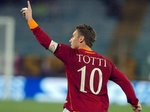
There is one man in particular who I hold up above all others: Fracesco Totti. Let me try to explain the reverence and awe that is felt for Totti in his home city of Rome. Totti is one of the best soccer players who ever lived, yet despite multi-million dollar offers, he has never played for any team but Roma (which is a second-rate team at best), and refuses to leave no matter what he is offered. He has the mark of the Roman legions, SPQR (senatus publicus quis Romanus) tattooed on his arm, and refuses to speak any Italian whatsoever, using only Roman dialect. Also, he resembles the paintings and statues of Emperors that abound in the city. Finally, Totti is a man of the people. He was born poor, acts like a peasant, and donates exorbitant amounts of money to the poor of Rome, as well as building schools and children's hospitals in Rome.


So, to Romans, who feel (and are) discriminated against by much of the rest of Italy, Totti is something of a hero. He is more Roman than Rome itself, the ideal that all Romans strive for, yet none can achieve. Needless to say, Francesco Totti is worshipped as a God, and even more extremely than any North American could worship an actor. Roman people refer to him as 'the king', but more recently he has taken on the name, The Patron Saint of Rome. People pray both to him, and for him. They swarm him on the streets hoping to touch him and receive his blessing. They throw their children at his feet in the hopes that his touch will bring them eternal luck. In short, Totti is treated the way saints, prophets, and holy men have been treated throughout history...and he is a soccer player.


Here, I could get into a long discussion about why our time worships people we see on TV in the manner that people in the past treated charismatic preachers. I could also get into a long discussion as to why Europeans treat celebrities with less awe than soccer players, while it is the opposite in North America. But, I'm not going to. What I want to stress here is two points. Firstly, although Totti's following may sound much like that of other celebrities, it is actually quite different. His has taken on a spiritual aura. He is simultaneously a hero, and icon, a cause, a man, and a saint, as well as a visual reminder of the past glories of Rome. This is far deeper than the cheap and fickle way in which North Americans idolize singers. Secondly, I realized that even I am not immune to the hero-worship that I was deriding earlier. Just because I revere soccer players rather than singers does not make me all that different (although I like to think that mine is a less tacky cause than Hollywood).


So, I guess you never know what you can learn about yourself, and the world around you when you least suspect it. For now, I'm going to watch some Totti highlights on youtube. Goodnight, and make sure you say a prayer for Er Pupone...may our Lord Francesco Totti watch over us all. Ciao.

Thursday, May 24, 2007

Catania Riots Revisited


A few months ago I was appalled at the violence that followed a soccer game in Catania, Sicily. That night in February, a police officer was killed by a teen with a homemade explosive for no good reason. Afterwards, I got to thinking about soccer violence in general, and I came to the conclusion that most of it actually has nothing to do with soccer at all. Instead, the most common causes are ethnic, political, economic, or social tensions that end up being expressed and released in the adrenaline fuelled atmosphere of the stadium. Add to this the fact that the stadium is often the only place one can release these feelings without fear of government reprisals, and you begin to understand why soccer seems to be accompanied by so much violence.

In the piece I wrote that night in February (which I re-posted below when I started this blog) I suggested that the violence in Catania was based on intense regionalism and resistance to both foreign and Italian influence in Sicily, as well as a new opportunity to re-open their ancient rivalry with Palermo (a rivalry that dates back to the early 9th century). With a series of investigations into the incident by the Italian government, a new, more sinister, picture is beginning to emerge...one that I, as a Sicilian, should not have overlooked.

It appears now that the Mafia was actually behind the violence, and that the police were specifically targeted by the rioters. Essentially, it was no riot. It was a well planned attack on the Italian state by a criminal organization (one that has declared war on Italy a more than once in the past few years) working through a group of intermediaries, in this case the Calcio Catania fan clubs. After looking at the evidence, I think I have to agree with this assessment. Before you make a conclusion, though, let me show you what the evidence actually is.

1 - Catania is a city that is almost completely controlled by the Mafia. It is estimated that 95% of businesses in the city pay protection money to the Mafia cosca (clan/family) that runs the area. For many children in the poorer parts of town, a life in organized crime is the most attractive option. A large number of them end up working for the Mafia in one way or another. Some deal drugs, some commit petty crimes, others commit murder; the important thing is that a large portion of the city's youth are linked to the Mafia in one way or another. As typical Italians (although I still have trouble thinking of Sicilians as Italian, as do many Sicilians themselves), a good proportion of these young men also belong to the fan clubs of the local soccer team: Calcio Catania.

2 - Many of the 'rioters' arrested that night, including the man suspected of killing Officer Fillipo Raciti, were linked to organized crime, either through prior convictions or current arrest warrants.

3 - The Catania fans within the stadium that night were waving a flag that made a personal threat to an Italian senator over a piece of anti-Mafia legislation. This flag was eventually traced back to the leader of the particular fan club involved in the rioting. It is probably no coincidence that his father just happens to be Catania's largest Mafia boss.

4 - The violence took place outside of the stadium and did not involve the fans of the rival team, Palermo. It is unheard of for soccer-related violence to be perpetrated on everyone EXCEPT for the opposing fans. Obviously, the soccer game was not the issue.

5 - A call was placed to the police BEFORE the real rioting had begun outside the stadium. As they rushed to the scene, the police were ambushed at specific and well-planned bottlenecks that allowed the rioters to do the most damage possible. I don't know of any unruly mob with this level of planning or discipline.

6 - Mafia informants have claimed that the entire night was a premeditated act orchestrated by the Mafia to disrupt the Italian state and to display their power. Imagine how much worse things could have gone if the Mafia had actually used any of their actual force, rather than just teens with rocks, bats, and homemade bombs. To be honest, the Italian government should be relieved that this didn't occur.

Slowly, from these and other pieces of evidence, a clearer picture begins to emerge. The conclusion that the Italian authorities have come to, and that I tend to agree with, is as follows: The Mafia planned the night's violence through a local Catania fan club that had extensive links with organized crime. Many of the poor and angry teens of Catania are usually willing to do anything for a bit of money, and that night seems to have been no exception. The violence resulted in the complete disruption of the nation for a period of about a week, as well as a serious shake-up within the government; results that the Mafia would have wanted. Although no proof exists that the Mafia organized anything, the authorities are convinced of their involvement, and so am I.

So, once again soccer violence turns out to be something else entirely. In this case it was actually just a small event in the eternal conflict between the Mafia and the Italian state. This is a purely regional problem that, unfortunately, has gotten out of hand. Hopefully something can be done in the future to remedy this situation, although I am not optimistic. Anyways, you can make your own conclusions, but in a case like this, it would be folly to underestimate the effects of organized crime in Sicily. Ciao for now, and once again, R.I.P. Fillipo Raciti.

Wednesday, April 18, 2007

R.I.P. Fillipo Raciti


I'd like to warn you, this is a long one. In February I was stunned by some things that happened in Catania, a city in Sicily that is very close to where my family is from. In fact, I'm pretty sure I have relatives living in Catania right now. So I wrote this 2500 word essay about soccer violence, which I am now posting here...so good luck, it's a long one:

The recent death of an Italian police officer in the aftermath of a soccer game has led me to ask some serious questions to which there are no sufficient answers. How could this happen? Why did it happen? Is this kind of situation preventable, and if so, at what cost? The issue of soccer related violence in Europe, and more particularly in Italy, is a complex one, and I’d like to examine it in some depth here. I hope this will lead both myself, and others to a better understanding of at least some of the implications and complications of hooliganism and violence in the western world.

First, it must be said that violence and soccer have gone hand in hand for generations, and thus, is not a new phenomenon. As the world game, soccer has come to be one of the most intense and universal mediums of cultural expression worldwide. From Ukrainian communism to Brazilian samba music, there is no limit to what soccer can represent. Unfortunately, as such a perfect mirror of humanity, soccer also represents and embodies the darker side of human nature. Racism, homophobia, exploitation, and murder accompany soccer’s more uplifting aspects wherever it is played. Fan violence and hooliganism are the most widespread of the negative aspects of the beautiful game, and it is these that have appeared most commonly in the news in recent months. What must be taken into account, however, is that the roots of soccer violence rarely lie in the game itself. More commonly, soccer becomes a relatively acceptable means to vent frustrations, partake in controlled chaos, and prosecute ancient vendettas.

Which brings us to Sicily, and the events of the Catania-Palermo game. What makes educated people in a modern western nation (not to mention a G7 nation and founding member of the European Union) throw homemade grenades with the intention of maiming their countrymen? I have my own theory, but first I’d like to examine a few of the most common explanations:

(1) SOCCER VIOLENCE IS EUROPE’S VERSION OF NORTH AMERICAN GANG VIOLENCE: Admittedly, there is some merit to this idea, and if it was the whole story then soccer violence could be looked upon as the lesser of two evils. Compare hundreds of gang related deaths in any North American city to the one or two soccer related deaths in any European city and you’ll see what I mean. The only problem with this explanation is that it ignores a few very important facts. Gangs still exist in European cities, although they are mostly replaced by soccer supporters’ clubs. Also, many of the hooligans are led by middle-aged men, thus straining the comparison with youth violence in North America. Regardless, I still think that a large percentage of soccer violence can be attributed to hooligans being a slightly more refined version of our gangsters (in that they rarely kill each other) and so in this respect, it just may be better for Europe than North American-style street gangs.

(2) SOCCER VIOLENCE IS COMMITTED BY A FEW BAD PEOPLE AND DOES NOT REFLECT POPULAR SENTIMENT: This idea, while appealing to our moral sensibilities, is not strictly true. I’m not sure when I last considered a few thousand people to be synonymous with just a few. The truth is, soccer violence and its supporters are far more widespread than many Europeans like to admit. For every hooligan throwing a rock, there are ten people cheering him on, and for every group of Ultras (as Italian fan clubs/hooligans are called) there is a cultural space in which they are accepted, and even idealized. All too often hooligans are looked upon with indulgence by others as “passionate lads” or “hard men who fight for what they believe in”. By ignoring the more brutal activities hooligans engage in, people are able to view them with a sort of nostalgia and naivety that legitimizes them and their actions. Also, hooligans are looked up to as folk heroes by thousands of young boys wanting to fit in with the “cool” kids. With such widespread support, even if it is for an imagined hooligan rather than a real one, it is impossible to assume that soccer violence is perpetuated by only the small few who actually throw the punches. On the contrary, it is deeply ingrained into many aspects of wider European culture. -As a side note, the huge success of hooligan literature and films provides quantifiable evidence for the validity of this argument.

(3) SOCCER VIOLENCE IS TRIBAL IN NATURE AND REFLECTS ANCIENT PREJUDICES, HATREDS, AND RIVALRIES: Of all the common explanations for soccer violence, this one holds true the most often. In fact, this has become the most widely accepted view concerning hooliganism worldwide. Take a quick look at some of the more intense rivalries around Europe and you’ll see why this idea is so popular. In Glasgow, the Celtic-Rangers rivalry represents hundreds of years of religious strife. Many clubs in Spain, including Barcelona, Espanyol, Real Sociedad, and Athletico Bilbao have become the spearheads of separatist movements, and teams from the Spanish capital of Madrid are met with flares and rocks whenever they travel to these regions. In Milan the Internazionale-AC Milan rivalry is political, pitting the left wing (Inter) against the right wing (AC Milan). The list goes on and on, but the conclusion is the same: Most soccer violence has its roots in something other than soccer, and the game merely provides an outlet for otherwise unrelated issues to be fought over, be they tribal, political, religious etc. This, however, can also be a positive aspect of soccer violence. How much better is it for Red Star Belgrade fans to fight Croatian supporters in the stadium than it is for them to go to war and massacre those same Croats? Pursuing tribal hatreds through soccer leads to far fewer deaths than pursuing them through state-sponsored ethnic wars. So I guess even this isn’t as bad as it could be.

Having reflected on these ideas, let us look at Sicily’s case in particular. First and foremost I would like to say that there are three people/groups of people responsible for the death of Filippo Raciti, and all must be brought to justice if his death is not to be in vain. Obviously the enraged Catania fans who rioted both during and after the game are most at fault, particularly the anonymous man who made an explosive at home and used it to murder a 38 year old father of three. This action is inexcusable, and though I myself am a huge Catania fan, I feel that serious sanctions must be taken against the club in order to get their supporters in line. Secondly, the authorities in charge of the match itself have a lot of explaining to do. Palermo and Catania’s mutual hatred goes back about 1200 years to the Arab invasion of Sicily and their creation of Palermo as the island’s capital. The last time these two teams met – in Palermo last September – around 100 Catania fans caused complete havoc, with fires, injuries, and the military police getting involved. How much more damage would 30,000 Catania fans do? Also, the last time a Sicilian team - Messina - visited Catania there was enough violence for the Italian soccer federation to sanction the club and prevent them from playing matches at home for about a month. Any intelligent person would conclude that explosive violence would accompany the Catania-Palermo match, and so the authorities are to blame for not putting in place better security measures, or even having the game played in a stadium outside of Catania. Finally, Mr. Farina, the game’s referee, must also face some sort of justice, as the riot that cost officer Raciti his life was a direct result of two disgusting calls he made during the match. Palermo won the game 2-1. Their first goal was clearly offside, and yet it was allowed. As offside calls are often misjudged, this could be forgiven. In light of the second goal however, it could not be. Palermo’s second goal was scored by Davide di Michele’s hand, and it was so obvious that one must question where exactly the referee’s paycheck was coming from. I know, blaming the referee for the fans’ response seems childish, but after having to delay the game due to tear gas wafting onto the field, and watching as dozens of people were rushed to the hospital, it should have been obvious to him that something was horribly wrong. More care could have been taken by Farina in his decisions later in the match, if only to defuse an already volatile situation. I wonder what went through his mind when he watched the replay on the news that evening, after the nation knew that a man had lost his life.

Having examined the general ideas concerning hooliganism, and the specific circumstances leading to the rioting in Catania, I would like to put forth my own theory to explain the escalating violence centred around soccer in modern European nations. Before I explain it though, I would like to describe how I came up with it. First of all, it is no secret that international soccer games tend to bring out nationalist sentiments in certain fans, who then attack the supporters of the “enemy” nation’s team. In this context, violence is often seen as legitimate because it is used in defence of one’s nation in the face of foreign opposition. Essentially, the fans get caught up in the moment and rational judgement gives way to mob violence fuelled by patriotism. In this violence, they find confirmation of their own national identity and, by extension, their personal identity as well. This is what is occurring when England fans throw chairs at non-British (and usually non-white) supporters while singing “Rule Britannia” and “God Save the Queen”. Secondly, I recently read Franklin Foer’s excellent book “How Soccer Explains the World” in which he uses soccer in all its highs and lows as a case study for globalization and regional resistance to it. This got me thinking more about regionalism, nationalism, globalization, and how the average person relates such ambiguous concepts to their daily lives. Finally, I noticed that the most intense soccer violence in recent years has occurred in very specific areas, namely those that have experienced crises over national identity within the last fifty or so years. Here is a long, but nowhere near exhaustive list of some of the more explosive rivalries: Czechs vs. Slovaks, Eastern Ukrainians vs. Western Ukrainians, Croats vs. Serbs, Macedonians vs. Greeks and Serbs, Basques and Catalans vs. Spanish, Protestants vs. Catholics throughout the UK, ethnic French teams vs. French teams supported by minorities, and Sicilians vs. Italians. It quickly becomes clear that there is something going on in these areas that goes beyond the obvious explanation of traditional ethnic hatreds and the extension of political rivalries into soccer rivalries. This new problem occurs at the level of the individual, and only turns into widespread rioting when many individuals feel the same way at the same time and decide to take some sort of action. This new and dangerous issue, I believe, is related to the curiously modern problem of identity.

Now that I’ve ranted for a while, here is my theory: The new and escalating violence centred in and around soccer stadiums in Sicily (and other European regions as well) is a form of protest against globalization, and resistance to the loss or compromise of already fragile and uncertain regional identities. The issue of identity in the modern world is rather too complex for me to get into here, but a quick summary of it should suffice. Though both national and ethnic identities are essentially constructed, they have become essential to the way people define themselves. When traditional identities are challenged, or when new ones are imposed, the situation becomes dangerous, and violence, or some other form of active resistance, is all too common. For a chilling example of what I mean, look no further than Rwanda, where a single ethnic group was splint into two by foreign invaders, resulting in the worst genocide of our time. The situation in Sicily, though less intense, has a lot to do with a regional identity crisis. Sicilians are quite different ethnically from most Italians, yet they are considered Italian by the rest of the world due to the Island being under the political rule of Italy. This would not be such a bad situation if their ethnic identity remained intact, but for close to one hundred years the Italian government actively attempted to assimilate Sicilians into the mainstream of Italian culture, even going so far as to ban teaching of the Sicilian language in schools (Can you imagine if the Canadian government banned Quebec from teaching French in school?). This government intervention created a long-standing cultural resistance within Sicily that erupted in violence numerous times in the twentieth century. Luckily, the Italian senate recently gave Sicily regional autonomy, and the crisis seemed to have been averted. Unfortunately – depending on your point of view – globalization has swept into Sicily in the form of European Union mandates. Now the challenge to Sicilian identity has re-emerged, bringing with it a renewed state of cultural resistance. The only place this resistance in not met immediately by police and other authorities is within the soccer stadium, where such resistance is usually explained away by the common ideas I discussed above. This relative freedom of expression found in the stadium thus provides a safe forum in which political resistance can be expressed without the imminent risk of jail time.

Thus when Italian – or even other Sicilian – teams travel to Sicily, the soccer stadium becomes the focal point for the defence of regional identity and a forum for both political and cultural resistance. That this resistance takes such a violent form can perhaps be explained by the above discussion on the nature of soccer violence, as well as the fact that political activism in Europe has traditionally been extremely violent (the record of European wars and revolutions speaks for itself). Obviously I’ve left a lot out of this discussion, and it’s more of a rant than an academic work, and some of my logical leaps may not follow easily from A to B, but it’s still a work in progress, so if you have any comments, criticisms or questions I would love to hear them. Thanks for your time, and please remember the family of Filippo Raciti.